Mostrando entradas con la etiqueta Likud. Mostrar todas las entradas

30 de mayo de 2019

Political Drama: Israel Goes to New Elections, Again

Political Drama: Israel Goes to New Elections, Again

Thursday, May 30, 2019 |  Israel Today Staff
The 21st Knesset has been dissolved just weeks after being sworn in. Knesset members voted on Wednesday evening by a majority of 74 to 45 to head to new elections after Prime Minister Netanyahu and his Likud party were unable to form the necessary majority coalition of 61 out of 120 parliament members.
New elections are now scheduled to take place on September 17, 2019.
So what happened?
We all recall in April that Netanyahu won re-election. However, although the prime minister did win most of the votes, he still needed to bring together a majority of at least 61 coalition partners out of the 120 Knesset members in order to set up a government.
Calculations showed that together with his own Likud and the other right-wing parties, Netanyahu had a clear path to an easy 65-seat majority in Knesset. However, after seven weeks of negotiations Netanyahu could not form a majority coalition.
Israeli law limits the time allowed to set up a government before the Knesset can decide to vote on dispersing the current government and head for new elections. The vote was held before that deadline at midnight Wednesday and off we go back to the ballot box.
Why couldn’t Netanyahu form a majority coalition?
As mentioned, the right-wing, made up of secular and religious parties, won most of the votes in the April 9 elections. Traditionally, religious parties will work together with the secular as long as they are allowed to maintain the status quo on issues like Jewish marriage, conversion, Sabbath laws and exemption for ultra-Orthodox youth from mandatory army service.
This time, Yisrael Beiteinu, a secular party lead by Avigdor Liberman, refused to join Netanyahu’s coalition unless the government passed a law requiring some ultra-Orthodox men to enlist in the army. This prompted most of the ultra-Orthodox parties to back away, too. A stalemate resulted, the clock ran out, and Netanyahu had to concede the move to new elections.
Game on
Within hours of the decision, the political blame games resumed with each side accusing the other for the breakdown.
“The Israeli public made a clear and unequivocal decision: That I would be prime minister and that the Likud would lead a right-wing government,” Netanyahu said after learning of the vote to disperse the Knesset. “The public chose me to lead the State of Israel. The various parties that ran for Knesset, many of them said they would support me. Sixty out of the 65 mandates granted to the right did what they undertook to do. One party did the exact opposite. Avigdor Liberman misled his voters. From the get-go, he had no intention of joining the government.”
Netanyahu continued to accusing Liberman of being not only “part of the left, he is the heart of the left.”
For his part, Liberman insists that his party’s commitment to their voters was clear from the start, and that includes upholding the laws requiring the ultra-Orthodox to enlist in the army. When he was asked by Netanyahu to soften, or else postpone implementation of those laws until after the new government was set up, the Liberman replied, “Under no circumstances will we let this happen.”
Here we go again, off to another fiery election campaign throughout our hot Israeli summer before new elections on September 17th, just in time for the Jewish New Year.
PHOTO: Tomer Neuberg / Flash90


21 de febrero de 2019

El nacionalismo judío más extremo retorna a las urnas en Israel


El nacionalismo judío más extremo retorna a las urnas en Israel

Netanyahu promete carteras en el Gobierno a los herederos de un partido racista proscrito

EL PAIS -  Jerusalén 21 FEB 2019 - 05:44 BRT

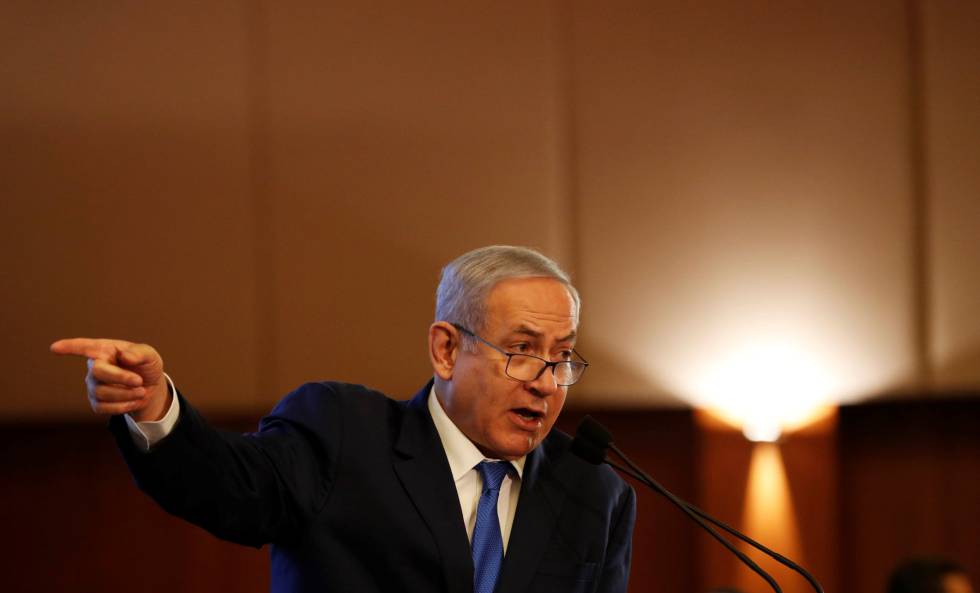
El primer ministro de Israel, Benjamín Netanyahu, en un acto en Jerusalén.
El primer ministro de Israel, Benjamín Netanyahu, en un acto en Jerusalén. RONEN ZVULUN REUTERS

El fantasma del extremismo político recorre el mundo, incluso en un país como Israel que ya contaba con una nutrida representación de partidos radicales. Los herederos de la formación encabezada por el rabino racista Meir Kahane, que fue prohibida hace tres décadas por propugnar la violencia y la deportación masiva de palestinos, se presentan en coalición con otros dos grupos de extrema derecha a las legislativas del próximo 9 de abril. El primer ministro, Benjamín Netanyahu ha forjado la alianza en interés propio. Con el objetivo de favorecer el voto útil conservador y garantizarse socios de coalición, les ha prometido carteras ministeriales para que cerraran el pacto.

Netanyahu se ha empleado a fondo en la defensa del flanco derecho de su partido, el conservador Likud, favorito en la campaña. El miércoles canceló un viaje previsto a Moscú, donde iba a intentar reconstruir con el presidente Vladímir Putin los puentes rotos tras el derribo un avión ruso en Siria el pasado septiembre, en un incidente en el que estuvieron involucrados cazas israelíes. El aplazamiento de la reconciliación con el Kremlin estuvo justificado por los cálculos políticos domésticos. Las encuestas electorales que situaban a la coalición de Hogar Judío, (el partido central de los colonos en Cisjordania), y Unión Nacional (ultraderecha nacionalista religiosa) por debajo del umbral del 3,25% de los votos que da acceso a la Kneset (Parlamento).

En la víspera del vencimiento, este jueves, del plazo para presentar candidaturas a las legislativas, el líder del Likud les hizo una oferta que no pudieron rechazar. Si integraban en su lista a Poder Judío, partido heredero del partido Kach del rabino Kahane, además de consolidar su representación parlamentaria recibirían dos ministerios (Educación y Vivienda) en la próxima legislatura. En una Cámara fragmentada por la proporcionalidad y la circunscripción nacional única, superar el listón mínimo fijado por ley electoral implica pasar de cero a cinco diputados dentro de una Kneset de 120 escaños.

Gran coalición de centro-izquierda

Los sondeos asignan ahora al Likud en torno a 30 parlamentarios, en teórico empate con una eventual asociación de los partidos de centro-izquierda encabezados por el exgeneral Benny Gantz, candidato sorpresa en estos comicios, y el exministro de Finanzas Yair Lapid, candidato de los sectores laicos moderados. Ambos han pactado en la madrugada de este jueves la composición de una lista conjunta en la que se integran los también antiguos jefes del Ejército Moshe Yaalon y Gabi Ashkenazi y el líder de Histadrut, la gran federación sindical israelí, Avi Nissenkorn. Gantz y Lapid se turnarán al frente del Gobierno si su candidatura con un programa centrado en los asuntos sociales y de seguridad consige sumar mayoría con otras fuerzas.

El riesgo evidente de desperdiciar votos en el campo conservador ante un bloque opositor unido ha servido de pretexto a Netanyahu –acosado por los casos de corrupción tras una década en el poder– para cortar el cordón sanitario impuesto desde hace más de 30 años a los kahanistas. Este movimiento judío extremista tuvo presencia en la Kneset entre 1984 y 1988, hasta que una reforma electoral vetó que el Kach se presentara a nuevos comicios a causa de su ideario racista. En 1994 el partido quedó definitivamente proscrito.

La exclusión de los no judíos (árabes y cristianos), considerados ciudadanos de segunda clase; el desplazamiento forzoso de población palestina a Jordania, la prohibición de los matrimonios de religión mixta, y el establecimiento de una teocracia conformaban el programa de Meir Kahane. Nacido en Estados Unidos y nacionalizado israelí, sus partidarios se caracterizaron por las acciones violentas. El rabino radical murió asesinado en 1990 en un hotel de Nueva York, adonde había escapado del ostracismo político en el Estado hebreo.
El partido Poder Judío está liderado por el exdiputado de ultraderecha Michael Ben Ari y por discípulos de Kahane como Benzi Gopstein, líder del grupo extremista Lehava. Gopstein fue acusado en 2015 por las comunidades cristianas de Tierra Santa de haber defendido en una yeshiva (escuela rabínica) la quema de iglesias por constituir “centros de idolatría”. Sus palabras se pronunciaron poco después del ataque incendiario sufrido en el santuario de Tabgha, cerca del mar de Galilea, donde la tradición cristiana sitúa el milagro de la multiplicación de los panes y los peces. “El pacto (de coalición electoral) servirá para impedir el establecimiento de un Gobierno de izquierdas, Dios nos libre”, reza el comunicado difundido por Poder Judío.

Su antecedente político, el proscrito partido Kach, figura en las listas de grupos terroristas de Estados Unidos y de la Unión Europea. Uno de sus seguidores, el colono radical Baruch Goldstein, mató a tiros a 29 palestinos en la mezquita de Ibrahim (la Tumba de los Patriarcas para los judíos) de Hebrón en 1994


21 de febrero de 2018

'The Netanyahu Era is Over'


'The Netanyahu Era is Over'

Wednesday, February 21, 2018 |  Israel Today Staff
Prime Minister Benjamin Netanyahu's legal woes amplified on Wednesday after a powerful close confidant turned state's witness in the escalating corruption investigations.
The Israel Police had already recommended Netanyahu's indictment in the two investigations known as Case 1000 and Case 2000, which respectively accuse the prime minister of accepting bribes in return for political favors, and of making an underhanded deal for more favorable media coverage.
Earlier this week, Police officials surprised the nation by unveiling Case 4000, in which Netanyahu is suspected, among other things, of doing political favors for Israel's Bezeq telecommunications company in exchange for favorable coverage on the popular Walla! online news portal, which is owned by Bezeq's controlling shareholder.
The situation for Netanyahu turned grim overnight when Communications Ministry director-general Shlomo Filber turned state's witness in the case.
Filber was reportedly Netanyahu's deal-making man in the Bezeq scandal, and his testimony could land the prime minister in jail.
That being the case, Israel's opposition on Wednesday started ramping up for early elections.
"The events of the last two days and recent hours make very clear: The Netanyahu era is over," wrote Zionist Union (Labor) party chief Avi Gabbay. "We must prepare for an election soon."
However, the most recent public opinion polls still show that the left wouldn't necessarily benefit from new elections at this time.
A survey conducted on behalf of The Jerusalem Post revealed that if elections were held today, Likud would remain the largest party in the Knesset, followed by the centrist Yesh Atid, with Labor coming in third with just over half the seats of Likud.
The mix of smaller parties would remain more or less as it is today, meaning it would still be easier to forge a right-wing coalition than a left-wing one.